

The Creative Studio – Feature
The Podcast Studio.
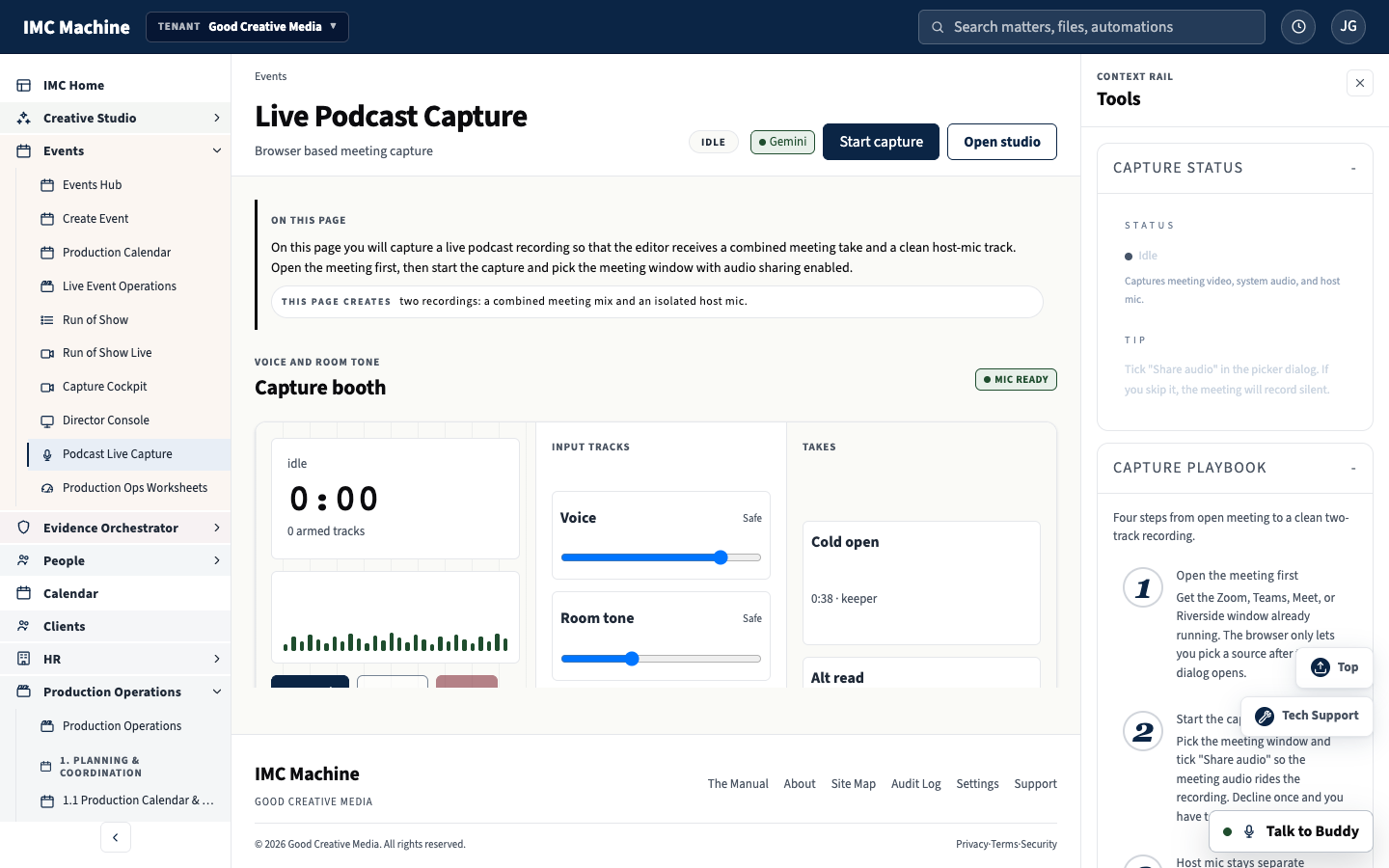
Multi-track podcast capture with auto-distribution to Spotify and Apple, plus short-form video output for Reels, Stories, YouTube Shorts, and TikTok. The capture is multi-track because the orchestra’s guest-conductor episode has two voices that should mix separately. The distribution is automated because the host should not be uploading MP3s on a Sunday night. The short-form output is included because the same episode that lands on Spotify becomes the week’s Reel calendar.
AI On This Page
Buddy Turns A Captioned Recording Into A Published Episode With Show Notes.
Buddy is The IMC Machine’s AI assistant. Talk, upload, or speak – Buddy turns what you send into structured records you approve before anything moves.
Talk To Buddy
“Cut The Dead Air At 14:32 And 22:15”
Buddy edits the timeline and updates the episode duration and chapter markers automatically.
Upload A Photo
Drop A Guest Bio Photo Or Headshot.
Buddy reads the bio, fills the episode’s guest record, and drafts an introduction in the host’s voice.
Voice Note
Voice The Episode Topic And Tone.
Buddy drafts a title, description, and chapter markers from your brief, ready to review before publish.
Buddy autofills are reviewable. Nothing publishes, files, or sends without a named human approval on the record.
Why it exists
Podcast-As-Marketing Has Eaten Radio For The Cultural Sector And CLE For The Legal Sector.
A regional orchestra runs a podcast of conversations with conductors, composers, and education-program directors that feeds the audience-development funnel year-round. A stand-up comedian’s three-night residency becomes a six-episode season that fills the year between bookings. A yoga instructor’s reflection on the year’s practice becomes a podcast that draws new students into the studio’s community. A university conservatory’s faculty-recital series turns into a podcast for the music-education community and a recruitment film for the next admissions cycle. A defense attorney’s CLE workshop becomes a podcast episode in the firm’s CLE series, a peer-visibility signal on LinkedIn, and an evergreen video lead magnet on the firm’s intake page. The conventional vendor stack for that work is a podcast hosting service, a podcast editor, a distribution tool, a short-form video producer, a YouTube channel manager, and a captioning vendor. Five or six separate vendors that do not share data and that the host reconciles by hand.
How It Works
Multi-Track Capture. Separate Stems. Mixdown. Show Notes From The Canonical Record. Audiograms For Social.
- Multi-track audio capture. The Studio captures multi-track audio so a guest interview can mix separately from the host, a co-host can sit on a separate stem, and a remote guest’s track can be processed independently of an in-room track.
- Separate stems per voice. The host’s stem can be processed for the host’s typical vocal profile. The guest’s stem can be processed for the room or the line condition the guest was on. The mixdown respects the difference between an in-room voice and a remote voice rather than collapsing them.
- Automated mixdown through the audio mixdown API. The output respects the loudness conventions the major podcast platforms expect. The mixdown is reproducible. The input stems are preserved on the canonical capture record and can be re-run if a stem needs reprocessing.
- Episode notes drafted from the canonical record. The IMC Composer drafts episode title, summary, guest credit, timestamped show notes, and transcript-derived chapter markers. The notes that land on Spotify and Apple read the same as the episode the host actually recorded.
- Auto-distribution to Spotify and Apple. The publish step targets Spotify and Apple as the primary distribution surfaces. The distribution event is recorded on the Distribution Ledger with publication URL, submission timestamp, and confirmation receipt preserved.
- Audiograms and short-form video for social. The audiogram generator and the short-form video lane produce vertical-aspect video derivatives from the canonical capture record for Reels, Stories, YouTube Shorts, and TikTok. One capture record, both surfaces.
Where it surfaces across the user-type inventory
The Universal Use Case, In Named Examples.
A Regional Orchestra
Guest conversations with conductors, composers, soloists, and education-program directors. Feeds the audience-development funnel year-round and supports grant reporting for educational programming.
A Stand-Up Residency
A three-night residency becomes a six-episode season, a YouTube channel of single-bit clips, an Instagram Reel calendar, a tour announcement video, and a TikTok cycle that fills the year between residencies.
A Yoga Workshop
The Saturday workshop’s reflection becomes a podcast episode on the year’s practice. Short clips become Reels and TikTok content that draws new students into the class community.
A Conservatory Recital Series
Faculty-recital audio becomes a podcast for the music-education community. The performances become the recruitment film for the next admissions cycle.
A CLE-Running Attorney
The CLE workshop’s recording becomes a podcast episode in the firm’s CLE series, a LinkedIn short-form video for peer visibility, and an evergreen video lead magnet on the firm’s intake page. CLE-credit documentation lives on the canonical record.
A Touring Band
Pre-tour interviews and post-show conversations become the band’s podcast through-line. A year of episodes around release campaigns and tour dates, with single-bit short-form clips for vertical-feed distribution.
For tenants that also use The Live Event Production Hub, the live captions surface (Deepgram streaming ASR with translation targets) feeds transcript-driven podcast show notes. A live-captioned event becomes a podcast episode with an indexable transcript the moment the recording is produced. A podcast episode with a clean transcript and an episode summary is dramatically more likely to surface in an AI-assistant answer than a podcast episode that is only an audio file.
Next Step
See The Podcast Studio Capture And Publish In One Pass.
Why This Matters
Capture Once, Publish To Four Formats.
The independent music economy has scaled past the gatekeeper era: independent artists earned about $5B from Spotify in 2024, roughly half of the platform’s total royaltiesA5. The U.S. arts and cultural sector added $1.2T to GDP in 2023, 4.2% of the national economyA1. None of that reaches an audience without consistent multi-platform publishing. The Podcast Studio is the universal use case in named examples: a regional orchestra’s guest-conductor series, a stand-up residency, a yoga workshop, a conservatory recital series, a CLE-running attorney, a touring band. Multi-track capture, separate stems, mixdown, show notes drafted by Buddy from the canonical record, audiograms for social, and auto-distribution to Spotify and Apple, so the host is not uploading MP3s on a Sunday night.
Sources
Where The Numbers Came From.
Sources and citations
- National Endowment for the Arts, 2025 Arts & Cultural Production Satellite Account release.
- National Independent Venue Association, State of Live (2024 / 2025); Pollstar coverage; Billboard.
- Texas Commission on the Arts; Americans for the Arts / Texas Arts Action Fund 2024 fact sheet; Fort Worth Report.
- The Broadway League, 2024 to 25 End-of-Season Statistics; Demographics of the Broadway Audience 2024 to 2025 (PDF).
- Spotify Newsroom, “How the Music Industry’s Cultural and Financial Impact Define Its Success in 2025.” (Loud & Clear data on independent artist payouts.)
- Side Door, Touring By The Numbers; Octiive, The Independent Music Market.
- National Endowment for the Arts, Indicator A.5: Labor Market Status of Artists and Cultural Workers (2025).
- Global Insight Services, Music Event Market Report; Berkeley Business Review on festival economics.
- Austin Monitor on SXSW’s 2024 economic impact; The Daily Texan.

Learn This Product
