
Capabilities / The Platform Map
One Live Event Record. Six Connected Stages.
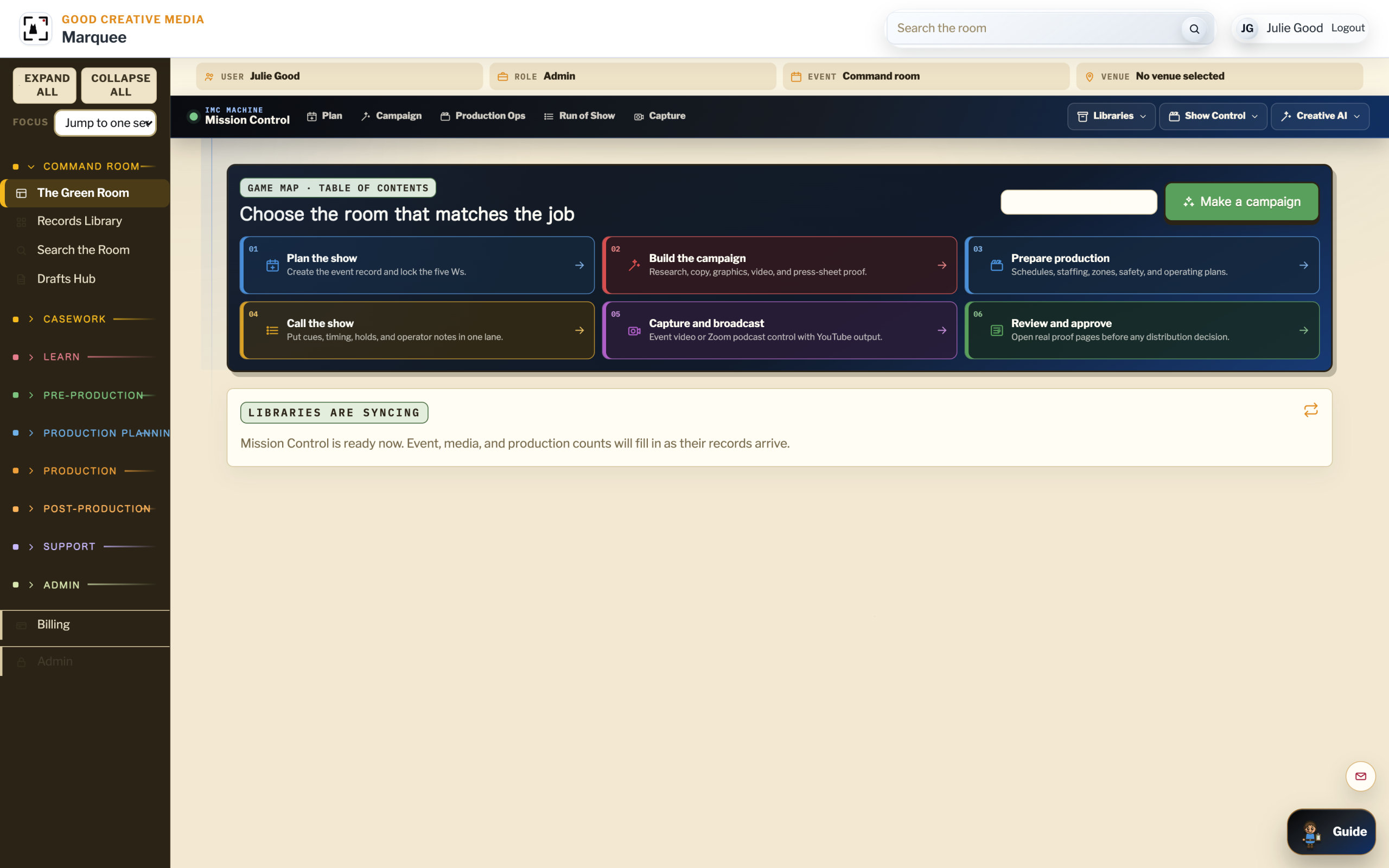
The event happens once. Its meaning and usefulness should not vanish at curtain call. Plan, capture, understand, create, approve, and deliver or archive the work around a live event or recorded occurrence. Five products share one verified event record while people retain judgment, authorship, and approval.
01 Five Products, One Record
Professional Capability Should Not Depend On Enterprise Scale.
Local theaters, musicians, youth orchestras, educators, independent producers, small organizations, and public interest and indigent defense legal teams deserve disciplined live-event capture, media, marketing, evidence, and documentation workflows. The platform expands what people can do while keeping human judgment, authorship, and approval in control. One evening on stage can become tomorrow’s audience, archive, lesson, or lasting record.
Product 01
Creative Campaign Studio
Turn a verified event record into researched, reviewable campaigns, press materials, social copy, and approved media.
Product 02
Live Event Production Hub
Plan, direct, capture, caption, stream, and archive performances, podcasts, open houses, hearings, and other live work.
Product 03
Evidence Orchestrator
Keep MP4 video, audio, photographs, documents, and transcripts connected for structured, review that stays traceable to its sources.
Product 04
Issue Spotter
Organize attorney-reviewed observations into questions linked to their sources and possible pathways. Counsel decides what matters and what is filed.
Product 05
Family Record
Confirm people, organize primary sources, and preserve a cited record from interviews, documents, photographs, and family events.
02 The Six-Stage Flow
Plan → Capture → Understand → Create → Approve → Deliver & Archive
A performance, podcast, open house, recorded incident, hearing, or family interview happens once. The IMC Machine keeps its source media, people, facts, decisions, approvals, and resulting work connected.
Plan
Confirm the people, place, schedule, source files, responsibilities, permissions, and requirements for the event or recorded occurrence.
Capture
Use supported video, audio, photographic, spatial-media, caption, and livestream workflows while preserving the source record.
Understand
AI assists with transcription, visual description, indexing, comparison, research, and gap finding. Source material remains distinguishable from derived analysis.
Create
Turn the verified record into media, marketing, operational documents, evidence reports, motion support drafts, or a cited family dossier.
Approve
Named people review, edit, decide, and approve. Attorneys control every legal conclusion and filing. Nothing external is released without authorized approval.
Deliver & Archive
Publish, export, file, share, or preserve approved output while keeping the source record, status, and decision trail together.
Human Authority
AI can assist with intake, organization, analysis, comparison, and drafting. It does not replace the producer, educator, researcher, investigator, or attorney responsible for the work. Human judgment, authorship, and approval remain in control.
Capability Status
Capabilities are labeled Live, Partial/Beta, Implemented: Verification Required, or Planned. Those labels distinguish demonstrated product from roadmap and should be reviewed on the relevant product or feature page.
03 The AI Reads The MP4
The Headline Capability,In Plain Language.
Most legal software treats a video file as an opaque object. You open it, you watch it, you write a paragraph about it, you move on. The IMC Machine treats the MP4 as readable. Google’s Gemini transcribes the audio, captions the visual content, and indexes the file by what is actually in it. Body cameras, dash cameras, interview audio, CCTV from a private investigator, surveillance from a family-law matter. Silent files get descriptive captions (“[engine idling, no audible speech, two figures cross the frame at 00:01:43]”). Every clip becomes part of the matter record the same way a deposition transcript does.[1]
Model-assisted review can compare a draft against the source record and surface disagreements as questions. The attorney remains responsible for the law, the citations, the decision to file, and the final document.
This is the platform’s specialty: making the live or recorded event itself reviewable, then keeping the approved media, marketing, evidence, or documentation connected to that source. Current capability varies by workflow, so the status labels on the relevant product and feature pages remain the authoritative guide.
04 A Day, Two People
Two Short Stories About What This Looks Like When You Use It.
Scenario
Wednesday, 9:14 AM. A Defense Attorney.
You are reviewing the matter that came in last night. A DWI arrest in Bexar County. The state already produced ninety-eight minutes of body-camera footage from two officers. You open the matter folder. The platform has already transcribed both videos, captioned the silent stretches, and indexed every spoken sentence with a timestamp.
You filter the transcript by “Miranda” and three returns surface, one of them three minutes after the captured incident began. You read the surrounding thirty seconds in plain text. You flag it. You open The Issue Spotter, pick the Article 39.14 (the Texas rule requiring the State to hand over its evidence to the defense) discovery demand template, and the canonical caption populates from the matter record. Three-AI consensus reviews the draft. You sign. The motion is filed before 10 AM.
Scenario
Thursday, 2:30 PM. A Venue Producer.
You are advancing a Friday show. The artist’s tour manager just emailed a revised rider with a new monitor setup. You open the event record. You drop the rider in the artist profile. The platform updates worksheet 1.4 (Crew Roster) to reflect the new monitor engineer call. Worksheet 1.6 (Marketing) flags that the door-time language in the social post draft is now out of sync with the schedule change.
You ask Buddy: “What still needs the marketing team’s attention before doors?” Buddy reads the campaign tracker and gives you three: the radio promo announcement, the Instagram countdown, and the press list confirm. You handle two. The third you hand to the publicist. By Friday at 8 PM the run of show is locked.
05 The Vocabulary
Words That Mean Something Specific In This Room.
- Canonical Record
- The single source-of-truth record for a piece of work. Event record for a show. Matter folder for a case. Everything downstream reads from it.
- Matter Folder
- The Drive folder where a legal matter lives. Client Files / Client / Matter / Evidence is the canonical path.
- Six Worksheets
- The numbered pre-production deliverables, 1.1 through 1.6: Schedule, Venue Survey, Meetings, Crew, Permits, Marketing.
- Three-AI Consensus
- Court-bound documents are reviewed by OpenAI’s ChatGPT, Anthropic’s Claude, and Google’s Gemini. All three must agree before the document is treated as final.
- White-Hat Compliance
- Texas Bar 7.01 through 7.06 adherence, plus same-day opt-out honoring and named-attorney approval on every solicitation.
- Approval Gate
- A required human review step before AI-generated output leaves the platform. No piece of content is published or filed on the platform’s authority alone.
- Run Of Show
- The timed cue document the stage manager calls from during a live event. Locked twenty-four hours before doors.
- Captured Incident
- The defense-side term for what the public booking record calls an arrest. Used in any text where the presumption of innocence applies.
06 Talk To Buddy About Your Work
Ask Anything Specific To Your Industry. Buddy Reads Your Work.
Buddy is the voice layer of the platform. Ask in plain language. Buddy reads your industry, your matter, your event, your campaign, and answers what you actually want to know.
- Ask Buddy how a feature works, with an example pulled from your matter or your event.
- Ask Buddy what a workflow will cost in time and money for your firm or your venue.
- Ask Buddy to draft the best plan for your specific business. Bring the goal. Buddy brings the path.
- Ask Buddy to read your evidence file, your contract, your rider, your campaign brief, and tell you what is missing.
07 Sources And Citations
Where The Specific Claims On This Page Come From.
- Google’s Gemini. The multimodal AI used by The IMC Machine for transcription, captioning, and indexing of MP4 evidence files. gemini.google.com
- Three-AI Consensus Posture. The platform’s requirement that every court-bound document pass review by OpenAI’s ChatGPT, Anthropic’s Claude, and Google’s Gemini before the attorney signs. Documented across The Evidence Orchestrator and Issue Spotter product pages. imcmachine.com / the-evidence-orchestrator
- Texas Disciplinary Rules of Professional Conduct, Part VII. The advertising and solicitation rules the platform’s white-hat compliance posture is built against. Texas Center for Legal Ethics. legalethicstexas.com
Sources are current as of May 23, 2026. None of this page is legal advice. The named attorney on any matter bears the final responsibility for the discovery posture, the motion practice, and the citations to authority in any filed document.
Ready To Walk The Room?
Create an account and Buddy will meet you inside the platform. Or book a walkthrough on a real matter, real event, or real campaign. We do not run generic demos. We run yours.
