
Keep The Story Beside The Source
Managed and BetaA family history should show what is known, where it came from, and what remains uncertain.
Bring interviews, photographs, letters, documents, recordings, places, dates, relationships, citations, permissions, contradictions, and unanswered questions into one source linked family record.
Book it. Build it. Sell it. Run it. Capture it. Share it.
The Family Record · Video Explainer
Keep the Story Beside the Source.
A family history deserves more than a polished story with the uncertainty quietly removed.
Strategic Communication and Innovation Designed by Julie Good, MATC · Good Creative Media · San Antonio, Texas
Genealogy Research Software: IMC Machine Family Record
See interviews, photographs, documents, recordings, dates, relationships, citations, contradictions, permissions, and unanswered questions become one source-linked family research record.
Watch on YouTubeThe Family Record is a managed beta. Family reviewers retain authority over names, relationships, access, corrections, permissions, and the final narrative. Source citation and human review remain central.
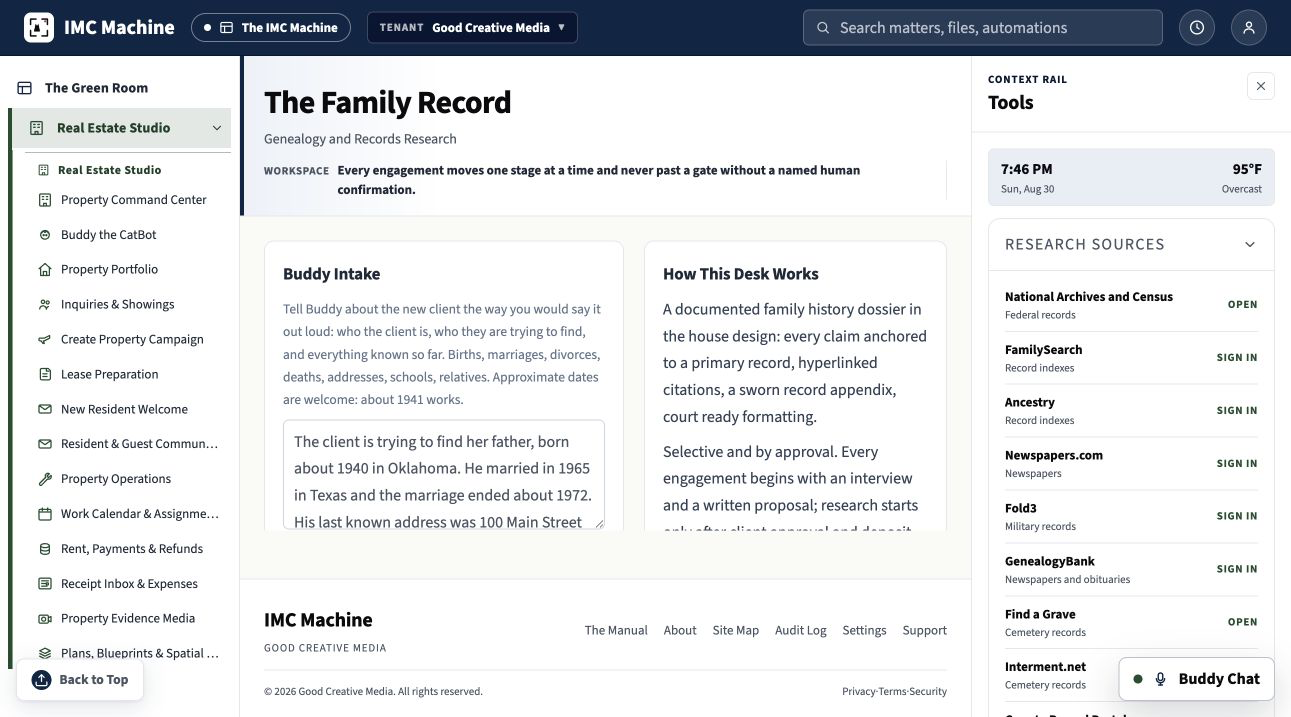
The Problem It Solves
The event record should not disappear between systems.
The Family Record
Families inherit boxes, stories, names, photographs, recordings, and confident recollections that do not always agree. A finished narrative can make uncertainty disappear. A useful family record preserves the story and the evidence without pretending they are the same thing.
Complete Workflow
Move from source to approved outcome.
The Family Record
- Define the family, subject, purpose, participants, permissions, privacy boundaries, sources, and responsible owner.
- Digitize or organize approved interviews, photographs, letters, records, media, places, dates, names, and relationships.
- Transcribe, describe, compare, research, cite, and identify agreements, conflicts, gaps, and questions.
- Let family reviewers correct names, relationships, dates, descriptions, access, and narrative choices.
- Prepare an approved chronology, dossier, story, media collection, map, memorial, reunion program, or private archive.
- Preserve the source links, citations, versions, permissions, uncertainties, and future research path.
What The User Gets
Useful work, visible responsibility, and a record worth keeping.
User outcomes
- A family narrative whose statements remain connected to sources.
- Privacy and permission choices visible throughout the work.
- Contradictions and uncertainty preserved instead of quietly edited away.
- A record that can grow across generations, events, interviews, and new discoveries.
Examples and samples
- A family records an elder’s interview and connects each story to photographs, documents, places, people, and review notes.
- A reunion becomes a live interview event, digitization day, family map, program, media archive, and next research plan.
- A musician’s family preserves recordings, performances, rights, press, photographs, instruments, oral history, and public or private access decisions.
- A historic property record connects owners, residents, renovations, photographs, maps, documents, interviews, and cited public history.
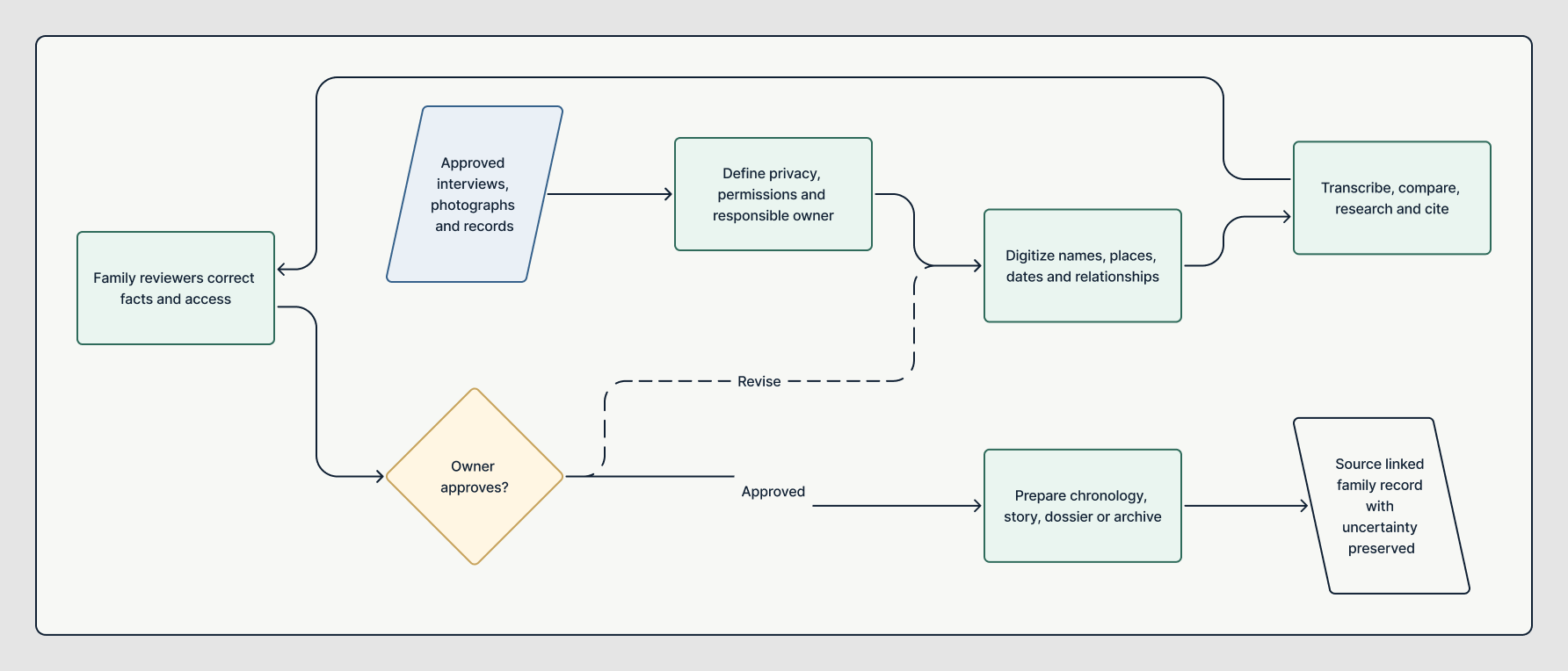
Visual Workflow
Family Record from source to approved outcome.
Follow the practical movement of the work. The machine organizes, drafts, compares, and prepares. The responsible person keeps authority over approval and release.
Evidence And Boundaries
Show what is current. Name what still requires people, providers, or a managed scope.
- The public Family Record product defines source linked genealogy and family history through records, interviews, photographs, timelines, citations, relationships, and uncertainty.
- Current core capabilities in intake, transcription, media organization, chronology, research, source records, review, dossier preparation, and archive support a managed Beta workflow.
- The product does not claim that generated relationships, historical conclusions, legal status, DNA interpretation, or identity findings are automatically true. Human review and source citation remain central.
Connected product areas
Read. Compare. Decide.
The website should do the explaining.
Review the actual application surface, the complete workflow, the practical outcomes, and the maturity boundary. Then open the application, browse the catalog, or request a written scope.
Book it. Build it. Sell it. Run it. Capture it. Share it.
