
Permission, Production, Delivery, Proof
Partial and Managed · Current for output and ledger records, Managed and Partial for provider delivery
Know what may be used. Know what was delivered.
Connect contracts, licenses, releases, credits, masters, derivatives, destination requirements, approval, delivery, and publication proof to the work they govern.
Book it. Build it. Sell it. Run it. Capture it. Share it.
Connected Product Systems
Two systems. One public operating desk.
Contracts, Rights, Licensing and Clearance
Keep agreements, deal terms, releases, licenses, credits, territories, dates, restrictions, approvals, and delivery obligations connected to the event, source file, product, property, or campaign they govern.
Digital Distribution and Release Operations
Prepare the master, derivatives, metadata, rights, credits, captions, artwork, copy, destination requirements, approvals, delivery package, and publication proof as one release record.
The Problem It Solves
The event record should not disappear between systems.
Contracts, Rights, Licensing and Clearance
A song is cleared for the room but not the stream. A photograph is licensed for the website but not a paid advertisement. A performer release is signed, yet nobody can find the version that covers the final edit. The creative work moves quickly. The permission record falls behind it.
Digital Distribution and Release Operations
An MP4 can be technically finished and commercially unusable. The caption file is missing. The vertical cut has the wrong date. The artist credit differs between the press release and the music metadata. Nobody recorded which master reached which platform. Distribution becomes a series of uploads without a reliable release record.
Complete Workflow
Move from source to approved outcome.
Contracts, Rights, Licensing and Clearance
- Identify the people, work, source media, property, performance, intended uses, territories, terms, and responsible reviewer.
- Record the relevant deal memo, contract, rider, license, release, credit, restriction, and expiration.
- Attach rights information to the actual asset, event, campaign, episode, property, or delivery package.
- Flag missing permission, conflicting terms, required credit, limited use, and human review.
- Route the record to the owner, producer, attorney, licensor, client, or other named authority.
- Preserve the approved terms, permitted delivery, proof, renewal date, and audit history.
Digital Distribution and Release Operations
- Define the release, audience, master source, approved versions, destinations, dates, owners, and success evidence.
- Prepare required MP3, MP4, image, document, caption, transcript, metadata, credit, and copy packages.
- Confirm rights, disclosures, accessibility, naming, dimensions, duration, loudness, and destination requirements.
- Route the complete release package through human approval.
- Deliver through configured providers or a managed operator and record the handoff.
- Preserve destination URLs, publication state, corrections, proof, results, and reusable source relationships in the Distribution Ledger.
What The User Gets
Useful work, visible responsibility, and a record worth keeping.
User outcomes
- Permissions visible before a file enters publication or distribution.
- Credits, territories, durations, and use limits attached to the work they control.
- Better handoffs among creator, producer, client, attorney, distributor, and archive.
- A durable rights history for future reuse, renewal, licensing, or withdrawal.
- Every derivative remains traceable to the approved master and source record.
- Platform specific output without platform specific factual drift.
- Clear ownership of approval, delivery, correction, and proof.
- A release history that can support reporting, licensing, sponsorship, archives, and the next campaign.
Examples and samples
- A theater records performance rights, union terms, music cues, performer releases, archival limits, and approved promotional excerpts.
- A film or music release connects masters, contributors, splits, artwork, samples, licenses, metadata, credits, and delivery status.
- A festival tracks artist agreements, sponsor use, vendor terms, photo releases, broadcast permission, and settlement obligations.
- A property campaign records listing authority, photographer rights, floor plan use, Matterport delivery, disclosures, and approval.
- A performance becomes a full program video, vertical clips, captions, stills, press copy, a podcast excerpt, and approved channel packages.
- A musician prepares MP3 and MP4 assets, credits, artwork, metadata, a release campaign, radio materials, and a distributor handoff.
- A filmmaker prepares screeners, trailers, captions, stills, credits, festival submissions, press materials, and delivery records.
- A public program prepares YouTube, website, email, social, archive, and funder proof from one approved source.
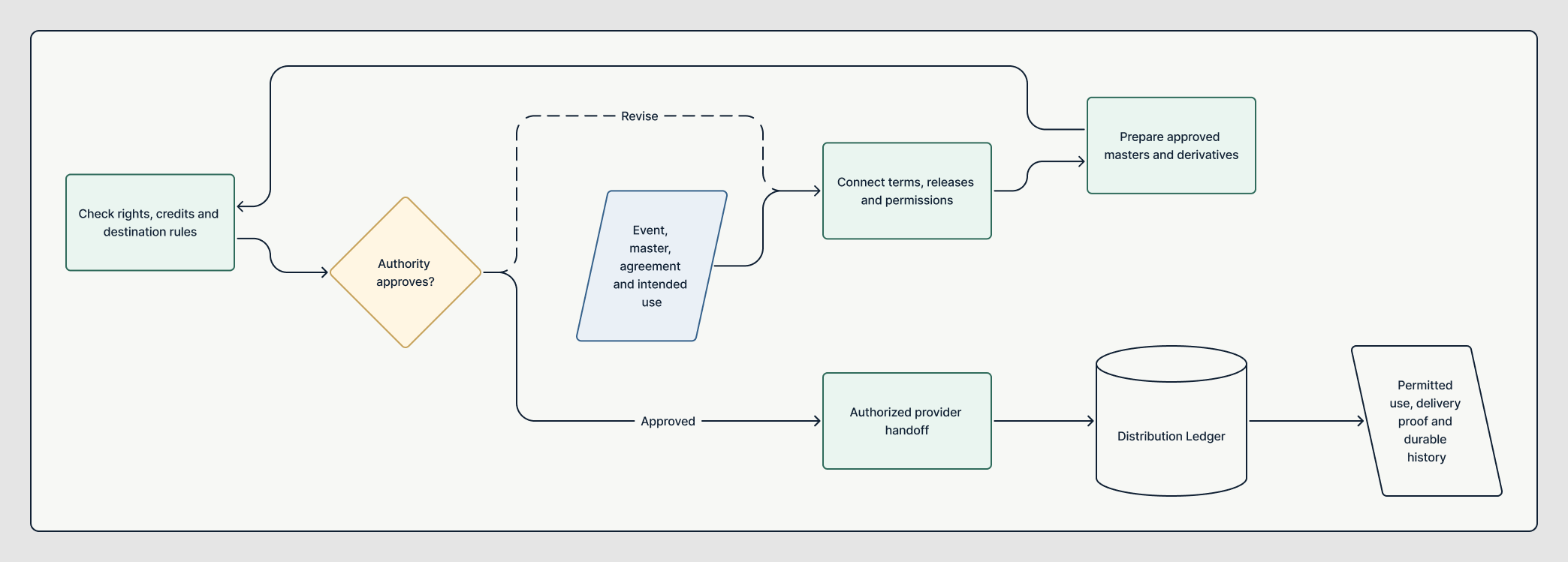
Visual Workflow
Rights, Licensing, and Distribution from source to approved outcome.
Follow the practical movement of the work. The machine organizes, drafts, compares, and prepares. The responsible person keeps authority over approval and release.
Evidence And Boundaries
Show what is current. Name what still requires people, providers, or a managed scope.
- Current and public surfaces support contract drafting workflows, riders, deal memos, release and license records, rights schemas, asset level rights, approval gates, and property rights records.
- Human legal review remains required. The product is not represented as universal contract lifecycle management, automatic rights clearance, or a substitute for counsel.
- Electronic signature, external rights databases, collection societies, union systems, and distributor acceptance depend on configured providers and verified integrations.
- Current surfaces document output generation, media and campaign records, captions, press and social packages, channel fields, approval, and the Distribution Ledger.
- The platform can prepare guided packages for many digital channels and preserve proof of managed or configured delivery.
- It does not claim universal direct master delivery to Spotify, Apple Music, DistroKid, TuneCore, CD Baby, film distributors, social networks, or every publishing provider.
Connected product areas
Read. Compare. Decide.
The website should do the explaining.
Review the actual application surface, the complete workflow, the practical outcomes, and the maturity boundary. Then open the application, browse the catalog, or request a written scope.
Book it. Build it. Sell it. Run it. Capture it. Share it.
