
From First Rehearsal To Final Archive
Current, with Partial rehearsal intelligence
Build the production in the language the room already uses.
Organize the calendar, departments, stage, cues, cast, crew, rehearsal, performance, capture, audience, publicity, and archive around one production record. The system does not ask theater to behave like generic project management.
Book it. Build it. Sell it. Run it. Capture it. Share it.
The Problem It Solves
The event record should not disappear between systems.
Theater and Performance Operations
The production lives in a calendar, a prompt book, a stage plot, a lighting file, a costume bible, a box office platform, a group text, a paper call sheet, and the institutional memory of the people doing the work. A changed entrance can reach the stage manager and miss the camera team. A revised schedule can reach the cast and miss the house.
Complete Workflow
Move from source to approved outcome.
Theater and Performance Operations
- Create the production, performance run, company, venue, rights, cast, crew, and calendar.
- Build the department worksheets, technical plan, stage plot, and show configuration.
- Manage rehearsals, calls, assignments, changes, and readiness.
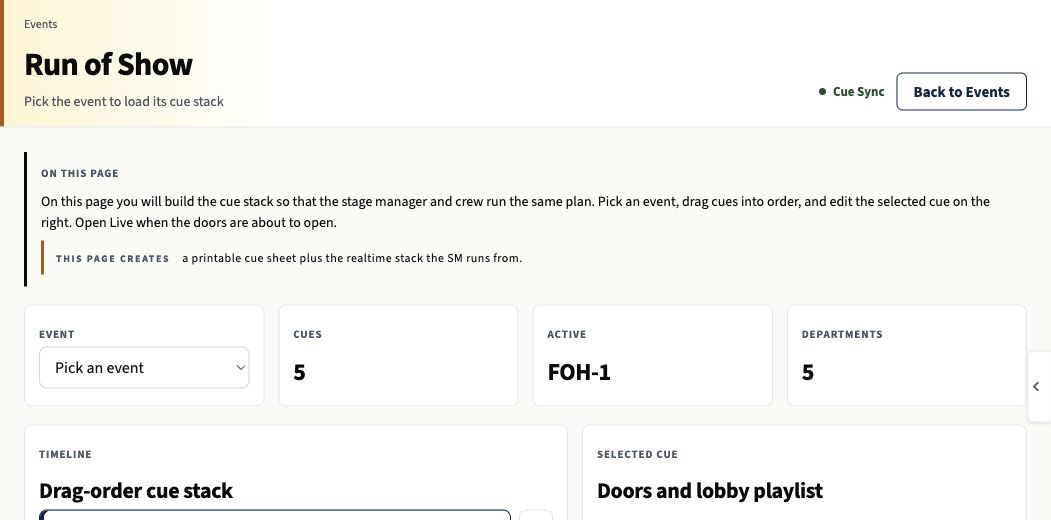
- Build and call the run of show with department cues and role context.
- Support line review, timed rehearsal markers, teleprompter reading, capture, captions, and audience operations.
- Close each performance into reports, media, publicity, settlement, and archive.
What The User Gets
Useful work, visible responsibility, and a record worth keeping.
User outcomes
- One current production record for artistic, technical, audience, and administrative work.
- Touring ready stage and show information that can be adapted without losing the original.
- Rehearsal and performance tools connected to the same schedule and script context.
- An archive that preserves both the production and the work required to make it happen.
Examples and samples
- A community theater builds stage plots, department calls, rehearsal schedules, cueing, ticketing, publicity, and a captured archive.
- A touring troupe adapts its house plan, run of show, staffing, hospitality, and press package for each presenter.
- An actor reviews timed lines before rehearsal.
- An emcee loads approved remarks into a full screen teleprompter with speed, type size, mirror, and fullscreen controls.
Visual Workflow
Theater and Performance Operations from source to approved outcome.
Follow the practical movement of the work. The machine organizes, drafts, compares, and prepares. The responsible person keeps authority over approval and release.

Evidence And Boundaries
Show what is current. Name what still requires people, providers, or a managed scope.
- Current implementation includes 26 production department worksheets plus the hub, stage plot editors, show configuration, run of show editing and live control, cue templates, production calendar, Line Rehearsal, and full screen teleprompter controls.
- The teleprompter is a current reading tool. It is not represented as an autonomous AI scene partner.
- Title only automatic production building and a spoken AI scene partner are Partial or Roadmap capabilities until end to end production proof exists.
Connected product areas
Read. Compare. Decide.
The website should do the explaining.
Review the actual application surface, the complete workflow, the practical outcomes, and the maturity boundary. Then open the application, browse the catalog, or request a written scope.
Book it. Build it. Sell it. Run it. Capture it. Share it.
