Products / The Live Event Production Hub

The Live Event Production Hub

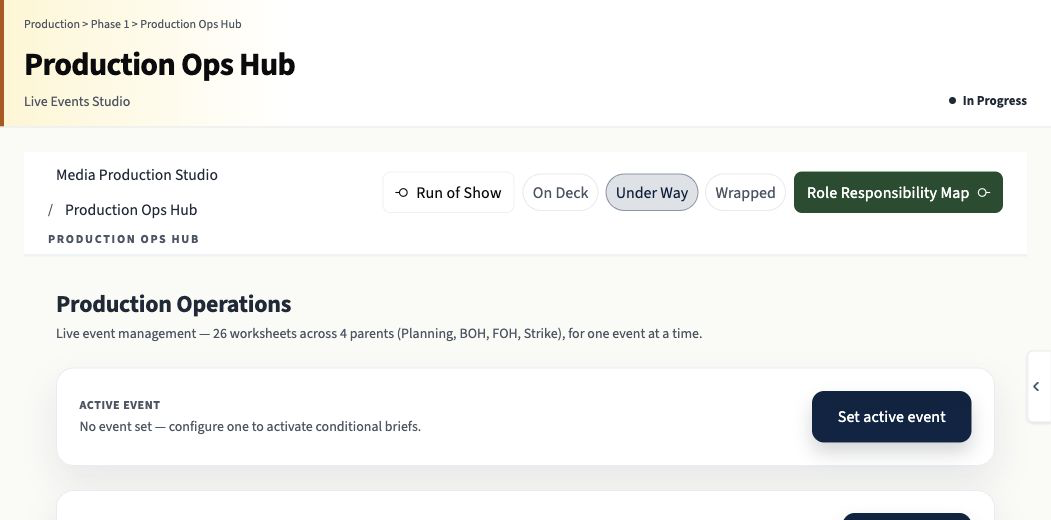
The Live Event Production Hub at 8:42 AM Wednesday, a touring stage manager's run-of-show timeline with six load-in tasks, three vendor confirmations pending, and the night's set list locked.
Live Event Production HubThe operations hub tracks the active event, worksheet progress, and production actions across planning, house, front-of-house, and strike.Click to enlarge.

The operational backbone of a live event, run from one shared workspace your whole team can read. You open one event record. The Hub holds the six pre-production worksheets in order, the run of show, the crew portal, the venue and artist profiles, the safety and permits, and the day-of-show ops modules. Every department reads from the same record, so the schedule the venue manager fills in is the schedule the stage manager calls from.

One Event Record Six Worksheets, In Order Reusable Profiles Day-Of Control Panel

01 The World You Walk Into

A Production Office With Six Worksheets, Always In The Same Order.

You are a producer, a stage manager, a venue manager, an artist manager, a crew lead, a front-of-house, a hospitality coordinator. The Production Hub was built around the production-office rhythm you already know. The vocabulary lives where you expect it. The schedule is the schedule. The run of show is the run of show. Load-in is at the door you wrote it at. The platform is fluent in the working language of a real production.

The Hub runs on one architectural choice: every department reads from the same event record. When the artist tour manager changes the soundcheck call by thirty minutes at 2 PM, the call shows up on the stage manager’s schedule, the crew portal text alert, the front-of-house brief, and the marketing post draft. You do not have to remember to update four documents. The platform updates them.

02 One Event Record, Every Department

The Canonical Event Record Is The Truth. Every Department Reads From It.

The event record is the source of truth for the show. Date, doors, set time, venue, artist(s), expected attendance, ticket link, age policy, hospitality rider, technical rider, schedule, run-of-show pointer, crew assignments, safety documentation. Every downstream surface inside the Hub reads from the record. Reusable venue and artist profiles mean the second show at the same room takes a fraction of the setup time. AI assistance on the paperwork has been measured to cut that work by about 40%.4 Build the venue profile once. Build the artist profile once. Every future event that links them pulls the canonical data automatically.

04 A Day Inside The Hub

A Story About Advancing A Show.

Scenario

Wednesday, 8:42 AM. A Touring Stage Manager.

You are advancing Friday’s show at a new venue you have never worked. You open the event record. The venue profile already has load-in directions, house PA inventory, fire code notes, and the on-site contact for tonight. You walk worksheet 1.2 (Venue Survey) against what is in the profile. You catch one missing item, the location of the production office. You add it. The next stage manager at this room will inherit your note.

You build the Run of Show against worksheet 1.1 (Schedule). The crew portal pulls the assignments from worksheet 1.4. By Friday at noon, every department head has the brief, the call time, and the contact. On margins that still sit about 25% below 2019, a missed update is expensive.2 By Friday at 8 PM, the show calls itself. The work behind it is real infrastructure, part of an independent-venue economy worth $153.1 billion a year.1

Read the Production Hub course

Scenario

Saturday, 11:53 PM. A Venue Manager After Last Call.

You are closing out the night. The Event Ops Modules already captured every department check-in, the noise complaint from the neighbor at 10:14 PM, the medical incident at 11:02 PM, and the front-of-house headcount at door close. You add one note about the load-out parking issue. You mark the event closed in Events Hub.

The record is now history. Settlement reads from it on Monday. The next show at this venue inherits the lessons. The neighbor complaint is logged in case the city asks. The medical incident is on the safety record under privilege. The wrap report is ready before you lock the door.

Read the Production Hub course

05 Buddy Inside The Hub

Buddy Reads Your Event Record. Buddy Reads Your Worksheets.

Buddy is the voice layer. Inside the Hub, Buddy knows your event record, your venue profile, your artist rider, and the state of your six worksheets. Ask in plain language.

  • “Buddy, which worksheet on this show still has open fields the venue manager has to fill in?”
  • “Buddy, what does this artist’s rider call for that the house PA cannot deliver?”
  • “Buddy, how much crew time will this load-in take if I hire the four-person crew instead of the six?”
  • “Buddy, draft the call sheet for tomorrow morning’s soundcheck.”

The Case In Numbers

Every Seat, Every Call Time, One Record.

Live events are a serious economic engine running on thin margins, where one missed update can cost a show. The Hub runs the whole production from one event record, so nothing falls through and the second show is faster than the first.

$153.1B

the economic output of independent venues, festivals, and promoters in a single year, supporting more than 907,000 jobs. The work that makes a show happen is real infrastructure.1

25%

how far below 2019 nonprofit theatre earned income still sits after inflation. Margins are thin, so every filled seat and every avoided mistake counts.2

$38.46

what each attendee spends around a show beyond the ticket. Fill the room and the room pays the neighborhood back.3

The Hub runs the whole show from one event record: six worksheets in order, the run of show, the crew portal, safety and permits, and day-of-show ops. When a call time changes at 2 PM, it changes on the stage manager’s schedule, the crew alert, and the front-of-house brief at the same moment, so no one works from a stale page. That is where the time goes back. A second show in the same room inherits the first show’s record, and AI assistance on the paperwork has been measured to cut task time by about 40%.4

06 Open The Hub

Ready To Run A Show On One System?

Create an account and Buddy will meet you inside the Production Hub. Bring an upcoming show. We will advance it together.

The Live Event Production Hub at 8:42 AM Wednesday, a touring stage manager's run-of-show timeline with six load-in tasks, three vendor confirmations pending, and the night's set list locked.

Live Event Production Hub

Run-of-Show, Crew, Capture, Livestream.

Calendars, vendor confirms, run-of-show, livestream relay. The operational backbone for venues, theaters, festivals, and touring books.

AI-assisted drafts are proposed for human review, not finished or filed work product. Adding to cart means you agree to the Terms and the AI Policy.

Pair It With The Creative Studio On The Same Event.

The Production Hub holds the operational backbone. The Creative Studio writes the announce, the press, and the social. Both read from the same event record. The show you advance is the show you announce.

Buy The Live Event Production Hub

Single Event, Season Pack, Or Unlimited. Plus On-Site Service When You Need It.

From one-time event setup to annual unlimited. Plus the festival operations, run-of-show prep, and operator training for venues and tours.

References

Where These Numbers Come From

  1. National Independent Venue Association, “The State of Live” (TEConomy Partners), 2025. nivassoc.org
  2. SMU DataArts & Theatre Communications Group, “Theatre Facts 2023,” 2025. culturaldata.org
  3. Americans for the Arts, “Arts & Economic Prosperity 6,” 2023. aep6.americansforthearts.org
  4. S. Noy & W. Zhang, “Experimental evidence on the productivity effects of generative artificial intelligence,” Science (MIT), 2023. science.org